Background#
Provenance#
The provenance description in PINK is based on PROV-O.
For more accurate descriptions of complex workflows involving spatial and temporal parts, PINK suggests an enhanced formalism.
A textual description of the provenance can be provided with dcterms:provenance.
However, for a semantic provenance description PROV-O should be used (since dcterms:provenance has no agreed semantics as discussed by DCAT-AP).
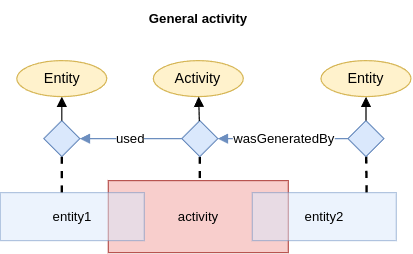
The basic building block of a provenance description is a prov:Activity with prov:Entity as input and output:
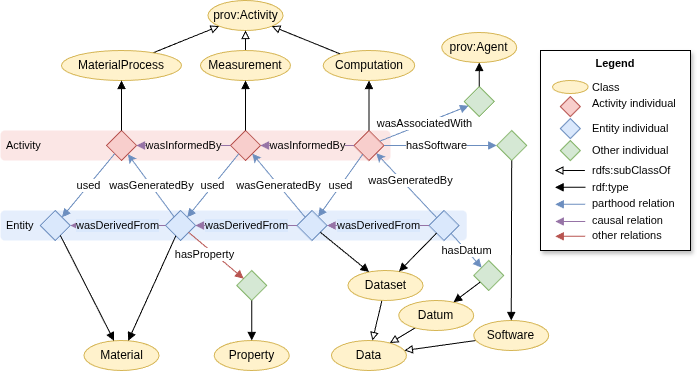
As shown in the taxonomy, this general process can be sub-categorised according to its input and output:

Traceability can be achieved by connecting a series (or network) of these basic building blocks.
By providing additional knowledge to the various process steps we get provenance. The figure below shows an example of a simple provenance graph, that combines three processes with some additional annotations.
Complex workflows with spatial and temporal parts#
An important aspect of provenance is to keep track on how a sample e.g. is cut into several specimens and how the specimens later may be joined in new configurations. Likewise, how a material is changed during a process or part of a process.
The figure below shows a material process (p) that changes a material (m).
The input and output of the material process are the temporal parts (m1 and m2) of the material, respectively.
The material process is driven by an agent (a), who’s temporal part (a1) is a participant (i.e. has an active role) in the process.
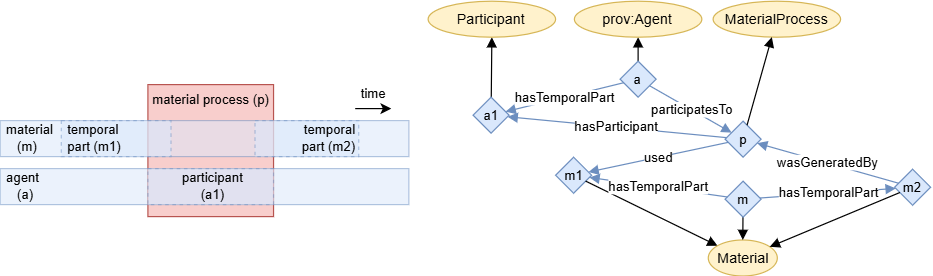
Concepts belonging to the PINK namespace in the figure above have been written in cursive.
Given the network of :used and :wasInformedBy relations, it is possible to infer :wasInformedBy and :wasDerivedFrom relations.
This is done by the reasoner (using SWRL rules that are added in [pink_annotation_schema.ttl]).
Taxonomy#
The taxonomy below shows a basic categorisation of the main concepts (OWL classes) in the PINK Annotation Schema. It unifies concepts from common vocabularies, like Dublin Core, PROV-O, DCAT and FOAF. This gives the adapted terms additional context. However, the taxonomy is intentionally weekly axiomated in order to facilitate alignment to different popular top-level ontologies, like EMMO, DOLCE and BFO.

At the top-level, the PINK Annotation Schema has the three root concepts from PROV-O:
prov:Entity: A physical, digital, conceptual, or other kind of thing with some fixed aspects. PROV-O lacks the accuracy of nominalism and allows both real and imaginary entities.prov:Activity: Something that occurs over a period of time and acts upon or with entities. Hence, its individuals have some temporal parts (that are not of the same type as the activity itself). An activity may include consuming, processing, transforming, modifying, relocating, using, or generating entities.foaf:Agent: A thing that does stuff (like person, group, software or physical artifact). The FOAF specification of a agent is very loose. The subclassprov:Agentprovides further context, by saying that aprov:agentbears some form of responsibility for an activity, the existence of an entity or the activity of another agent.
See the reference documentation, for a description of all the other concepts.
Relations#
The PINK Annotation Schema includes three types of relations: parthood relations, causal relations and semiotic relations.
The The PINK Annotation Schema incorporate parthood and causal relations from PROV-O and Dublin Core and give them enhanced semantic meaning. This is based on the mereocausal theory by Zaccarini et. al., but is simplified and adapted to the needs of PINK.
For improved semantic expressiveness and to support logical validation, the PINK Annotation Schema adds characteristics to the standard PROV-O object properties. According to the guiding principles, the characteristics is added to PINK-specific subproperties of the PROV-O object properties. Such semantically enhanced subclass relations of corresponding PROV-O and Dublin Core relations are written in cursive in the figure above.
[!TIP] Object property chracteristics is explained in the Protégé documentation.
Antisymmetric (not included in OWL) is a weaker form of asymmetric: if
x -> y, theny -> xif and only ifx = y. This is not the case for asymmetric relations, since they exclude the equalityx = y.
Parthood relations#
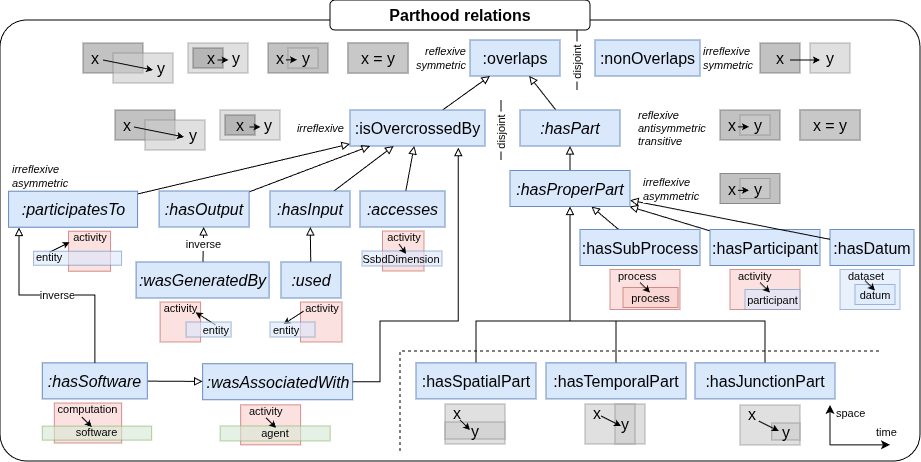
The above figure includes graphical illustrations of the parthood relations. The colour scheme in these illustrations represents activities in red, entities in blue, agents in green and unspecified nature (activity/entity/agent) in gray. The arrow illustrates the direction of the relation.
Causal relations#
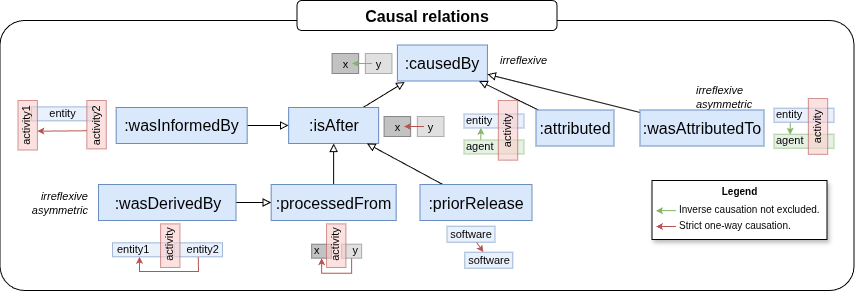
Causal relations focuses on whether an individual is influenced by another.
In PROV-O this is described by the fundamental relation prov:wasInfluencedBy.
In PINK we introduce the toplevel subclass :causedBy as a subclass of prov:wasInfluencedBy.
The causal relations currently included in the PINK Annotation Schema are shown in the figure below.
Most of these relations are indirect causations mediated by an activity.
These chains of causations have been expressed using SWRL rules.
The relations starting with “:was” are subclasses of the corresponding relations in PROV-O.
The :attributed and :wasAttributedTo are the inverse of each other.
Semiotic relations#
Semiotic relations take part in a triadic semiotic meaning-making process, where an ‘interpreter’ connects a ‘sign’ (e.g. a property) to an entity (called ‘referent’). The semiotic relations in the PINK Annotation Scheme are inspirred by EMMO, which in turn is based on the semiotic theory by Charles Sanders Peirce (1839-1914). Semiotic relations can be seen as shortcuts that replaces a series of complex causal interactions with a single relation.

An important use of semiotics is to support the scientific view that a property is not an intrinsic quality of an entity, but something that is measured or determined by an interpreter.
For example, to determine the toxicity of a chemical substance you have to measure (or calculate or estimate) it. And the result depends on how it is measured/calculated/estimated.
Class-level documentation#
Provenance is about what has happened. PROV-O is intended to describe provenance information. In PINK we also want to describe general workflows before they are executed. That is, to describe something that can happen.
Since we don’t know whether the workflow actually will be executed, we can’t create individuals for it. Hence, what can happen must be described at class level (TBox-level). Thus, specific subclasses of prov:Activity are made.
In Manchester syntax, this may be expressed as follows
Class: uob:SpecificToxicityComputation
    subClassOf: pink:Computation
    subClassOf: pink:hasInput some uob:ToxicityComputationInput
    subClassOf: pink:hasOutput some uob:ToxicityComputationOutput
    subClassOf: pink:hasSoftware some uob:ToxicitySoftware
where uob is the prefix of the application ontology defining the computation.
PINK provides tooling (based on [Tripper]) to help providing class-level documentation.
This is done the normal way using spreadsheets, but with the @type keyword replaced by subClassOf (@type is implicit and would always be owl:Class).
For example, the above declaration of a computation could provided as follows:
@id |
@type |
subClassOf |
description |
hasSoftware |
hasInput |
hasOutput |
|---|---|---|---|---|---|---|
uob:SpecificToxicityComputation |
owl:Class |
pink:Computiation |
… |
uob:ToxicitySoftware |
uob:ToxicityComputationInput |
uob:ToxicityComputationOutput |
where the entries under hasInput and hasOutput refer to dataset subclasses.
These dataset classes can be documented in a similar way.
@id |
@type |
subClassOf |
description |
… |
|---|---|---|---|---|
uob:ToxicityComputationInput |
owl:Class |
pink:Dataset |
… |
… |
uob:ToxicityComputationOutput |
owl:Class |
pink:Dataset |
… |
… |