The Models module of the PINK Annotation Schema#
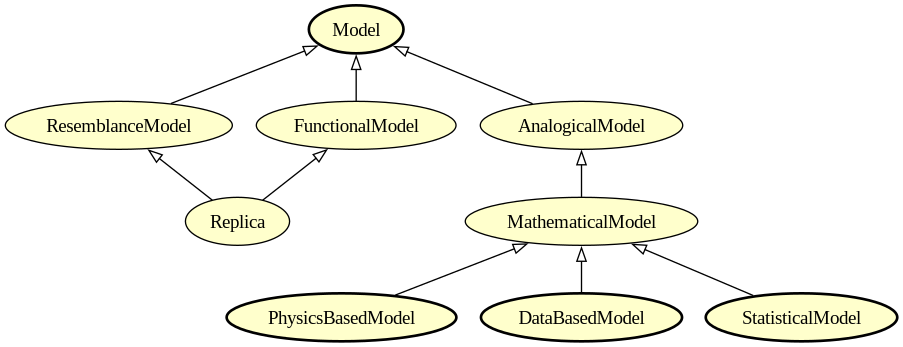
A model is a useful simplified description of a selected part of the world. The PINK Annotation Schema categorises models as shown in the figures below.
Physics-based models#
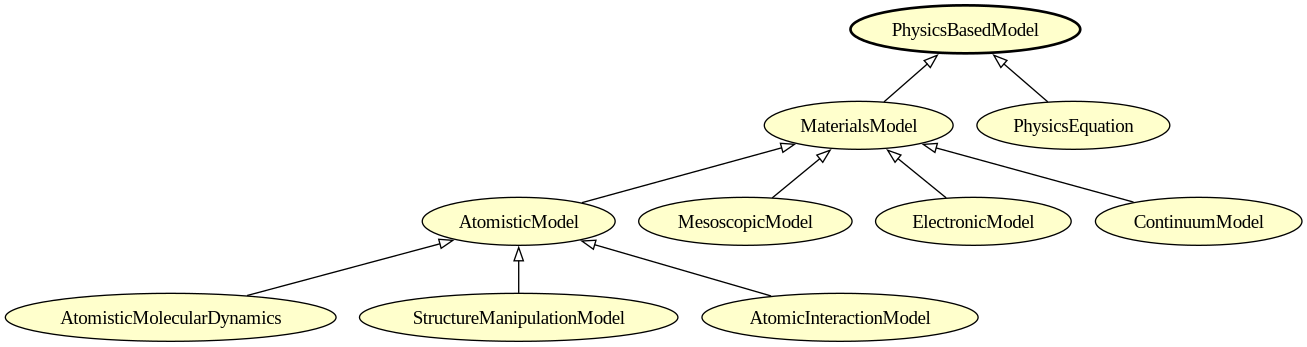
Physics-based models are mathematical models based on a fundamental physics theory which defines the relations between physics quantities of an entity.
The categorisation of physics-based models is anchored in the CEN Workshop Agreement, CWA 17284 Materials modelling - terminology, classification and metadata.
Statistical models#
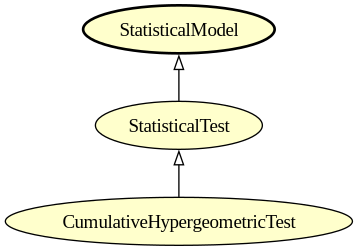
Statistical models are mathematical models that embodies a set of statistical assumptions concerning the generation of sample data (and similar data from a larger population).
Data-based models#
Data-based models are mathematical models based on observed data, measurements, or experimental results.
The article Artificial intelligence in product lifecycle management by Wang et al. (2021) has been used as a basis for the categorisation of data-based models. Additional subclasses relevant to PINK have also been added. However, since this article is from before the introduction of the transformer architecture in 2023, the categorisation of modern generative AI is currently rather limited.

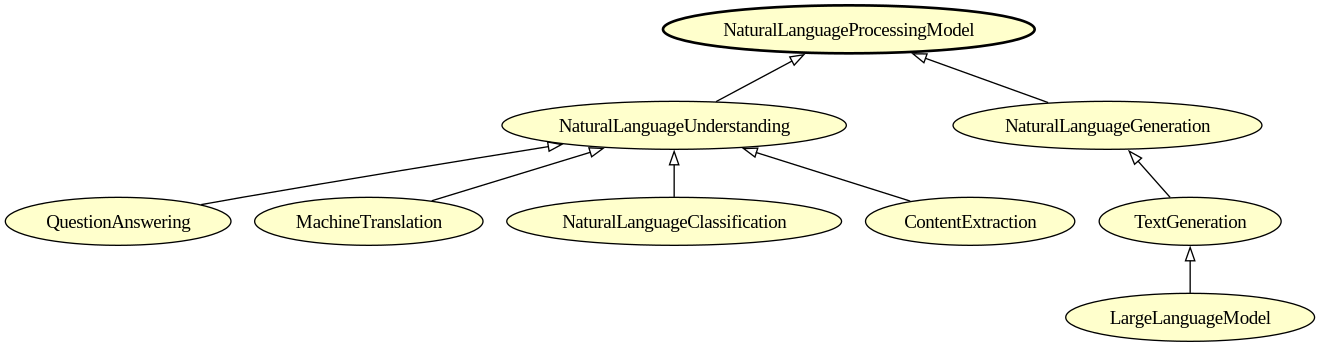
Within AI, natural language processsing (NLP) and machine learning is further expanded:

Finally, machine learning has the sub-branches supervised learning and deep learning:


See the reference documentation for details.